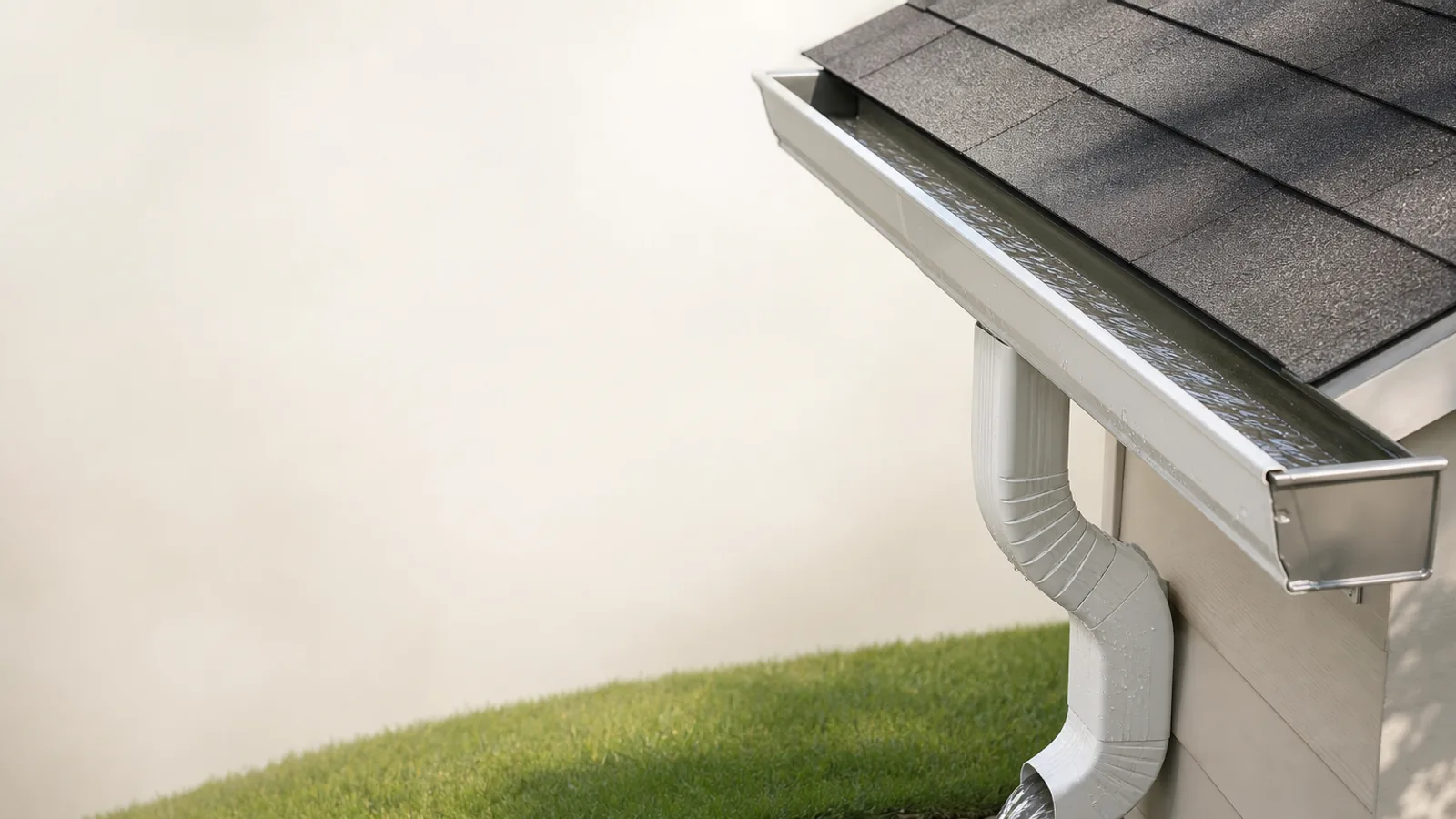
If your gutters are cleaned correctly, you should see water moving off your roof, through downspouts, and away from your foundation without overflow or pooling. This guide explains what a good cleaning can deliver, what it cannot fix, and how to tell if you got your money’s worth.
What should clean, working gutters look like after a service visit?
After a proper gutter cleaning, you should be able to watch rainwater hit your roof, run into the gutters, travel to the downspouts, and exit into your yard without spilling over the edges. Building and municipal guidance from federal and local agencies describe this same outcome: roof runoff should be captured, carried through the gutter system, and released away from the house so it does not soak the soil at your foundation or splash your siding. In other words, the system’s job is not just to be free of leaves, but to reliably move water from point A to point B.
You can confirm this visually the next time it rains. Look up at the eaves. Water should not be shooting past the gutter, dripping behind it, or pouring over the front like a waterfall. When you walk around the house, you should see water exiting at the downspouts in a steady stream, then flowing onto a splash block, extension, or sloped soil that carries it away. Municipal guidance for homeowners notes that properly maintained gutters and downspouts help prevent pooling around the house, which in turn reduces the risk of basement moisture, settlement, and erosion.
- Water enters the gutter instead of overshooting the roof edge.
- There is no continuous sheet of water overflowing the front of the gutter.
- Downspouts run with a steady stream, not a trickle or nothing at all.
- Water leaving the downspouts moves away from the foundation instead of pooling.
What exactly does gutter cleaning fix and what does it not fix?
A thorough cleaning is very good at one thing: removing material that does not belong in the gutters. That includes leaves, twigs, seed pods, roofing granules, and even small branches or toys that landed on the roof. When this debris is scooped out and flushed, downspouts that were clogged will usually start flowing again. Trade contractors who do this work every day are clear that cleaning restores flow that was blocked by organic debris, but its power mostly stops there.
Cleaning alone will not correct gutters that were installed with the wrong slope, are sagging away from the fascia, or are physically bent from ladders or ice. It also cannot relocate a downspout to a better corner of the house or change where that downspout discharges into your yard. If your system sends water out right beside your foundation, or into a low spot that already puddles, no amount of scooping leaves will change that outcome. Think of cleaning as returning the system to its original design performance. If the design or installation is flawed, you may need repair, re-sloping, or re-routing in addition to cleaning.
- Cleaning removes leaves, twigs, and roof grit that block water flow.
- Cleaning clears many downspout clogs so they drain again.
- Cleaning does not fix gutters that are pitched the wrong way.
- Cleaning does not repair crushed, disconnected, or missing sections of downspout.
How should cleaned gutters move water away from your foundation?
Even the cleanest gutters will not protect your home if the water they carry ends up soaking the soil right at the base of your walls. Federal building and indoor air guidance both call for roof runoff to be discharged several feet away from the house. Some resources describe extensions or piping that release water about 5 to 6 feet from the foundation, while others require an even longer run when water is sent to an underground system. The logic is the same in every case. The farther you can reliably move water from your foundation, the less likely it is to work its way into your basement or crawlspace.
Local stormwater departments echo this guidance by urging homeowners to verify that downspouts have functional extensions and that the ground slopes away from the building in the first several feet. After cleaning, you should expect your contractor to confirm that downspouts are open and that any existing extensions, splash blocks, or diverters are positioned to send water away. If your home has no extensions at all, or they are disconnected, cleaning will still help but you will not get the full benefit until downspout discharge and yard grading are addressed.
- Water should exit on soil or hardscape that tilts away from the house.
- Downspout extensions should be long enough to move water noticeably outward.
- Splash blocks or extenders should sit firmly under the downspout mouth.
- Low spots beside the foundation should be noted for grading or drainage work.
How often should you expect to schedule gutter cleaning to keep results?
Most official maintenance guidelines recommend cleaning gutters at least twice a year, usually in spring and fall, so they are ready for heavy seasonal rains. Inspectors in historic districts, for example, advise homeowners to plan for this minimum schedule and to increase the frequency if there are heavy leaf loads from nearby trees. The idea is to prevent debris from building up to the point that it blocks flow, causes overflow, or traps moisture against wood trim for long periods. Waiting until water is already pouring over the edge usually means you are late for service.
Your actual schedule may need to be more aggressive than the baseline advice. If your home is under pine trees that drop needles year round or you are in a neighborhood with a lot of mature hardwoods, the gutters can fill quickly. In those conditions, you might find that annual or twice-yearly cleanings simply are not enough to keep things running smoothly. On the other hand, a newer home in a more open landscape might manage well with the standard two visits. A good provider will help you set expectations and may suggest adding gutter guards or screens where debris loads are consistently high.
How can you tell if the gutter cleaning you bought was actually done well?
You do not need to climb a ladder to check whether you got a thorough cleaning. There are simple ground-level checks you can do once the crew has left. First, look along the bottoms of the gutters for any obvious remaining vegetation sticking up from the top. Bits of stuck debris can happen, but large clumps suggest the work was rushed. Next, turn to the downspouts. If it rains shortly after the visit, walk outside and watch the exits. You want a steady, healthy stream rather than a dribble, no movement, or water leaking through seams higher up.
Guidelines for exterior maintenance also recommend deliberately watching your gutters during or right after a storm. When properly cleaned and functioning, water should collect inside the gutters and move along to the outlets without spilling over the edge. If you see repeated spillover in the same location, that can signal a remaining blockage, a low spot or improper slope that cleaning cannot fix, or simply a volume problem during very intense rain. A low-pressure hose test can also help. Have someone run water on the roof, then listen at the downspouts for clear flow. If you see or hear backups or gurgling, you may need your provider to come back or to quote repair work.
What results are realistic to expect from a basic gutter cleaning service visit?
When you hire a company for standard gutter cleaning, you are usually buying labor to clear debris and restore basic flow within the system as it exists today. That typically includes hand removal or scooping of leaves and loose material, bagging or dispersing the debris, and flushing the gutters and downspouts with water to confirm that clogs are gone. Many providers will also do a quick visual check of fasteners, joints, and outlets as they move around the roofline. After this work, you should reasonably expect your gutters to handle ordinary rains without visible overflow or dripping from seams that are simply blocked.
What is not automatically included at a cleaning-only visit is any redesign or replacement. If the technician finds a crushed downspout, a section of gutter that has pulled away from the fascia, or a run that pitches in the wrong direction, those are usually quoted as separate repair items. Trade publications make this distinction clear so homeowners do not expect cleaning alone to correct structural or layout problems. Before you schedule, ask the company how they handle issues they find and whether they can also provide repair or recommend follow-up services. When you understand the limits of what you bought, you can judge the results fairly and decide if your system needs additional work beyond routine cleaning or possibly future upgrades like professional gutter cleaning with guard installation to cut down on how often this is needed.
- undefined
- undefined
- undefined
- undefined
- undefined
- undefined
- undefined
- undefined
Frequently asked questions
- What should I expect after my gutters are professionally cleaned?
- After a proper cleaning, your gutters should accept rainwater without it spilling over the front edge, and your downspouts should run freely during storms. You should also see water exiting onto splash blocks, extensions, or graded soil that carries it away from the foundation. If overflow or standing water at the base of your house continues, the system may need repair or layout changes in addition to cleaning.
- Can gutter cleaning fix water pooling around my foundation?
- Cleaning helps by restoring the flow through gutters and downspouts so water is not simply pouring off the roof edge right beside your house. However, if your downspouts end too close to the foundation or the yard is graded flat or toward the house, cleaning alone will not stop pooling. In those cases, you may need longer extensions, changes to where downspouts discharge, or grading work.
- How often should gutters be cleaned to keep them working properly?
- Many maintenance guidelines suggest cleaning gutters at least twice a year, typically in spring and fall, so they are clear for seasonal rains. Homes under heavy tree cover or with many nearby pines may need more frequent service because debris accumulates faster. Your ideal schedule depends on your roof size, nearby trees, and local weather patterns.
- Why do my gutters still overflow even after I had them cleaned?
- If gutters overflow after cleaning, there may be a structural or design issue rather than a debris problem. Common causes include sections that are not sloped correctly toward the downspouts, sagging or low spots, or downspouts that simply cannot handle the volume of water from a large roof area. In these cases, you may need repair, re-sloping, or additional downspouts instead of another cleaning.
- Should a gutter cleaning service also adjust my downspouts or extensions?
- Basic cleaning usually focuses on removing debris and flushing the system, not on redesigning it. Many providers will reposition loose splash blocks or reattach simple extensions as part of the visit, but adding new extensions, burying pipes, or rerouting downspouts is typically quoted separately. It is worth asking in advance what adjustments are included so you know what to expect.
- How can I tell if downspouts are draining properly after cleaning?
- The simplest way is to observe them during a rainstorm or run water from a hose on the roof while someone watches the outlets. You should see a strong, uninterrupted flow, and there should be no water leaking from joints along the downspout itself. If an outlet only trickles, gurgles loudly, or shows no flow while the gutters are clearly full, there may still be a blockage or a crushed section that needs repair.
- Is it normal to see some small debris in the gutters right after cleaning?
- A few small leaves or roof granules left behind are common and usually do not affect performance. What is not normal is seeing thick mats of leaves, seedlings sprouting, or large clumps in corners or near outlets immediately after a service visit. If you notice significant leftover debris, it is reasonable to contact the provider and ask whether those areas were fully addressed.