New national copper gutter cost data and fresh guidance on historic homes show that the wrong gutter profile can both clash with your facade and waste money. If you own an older home in the Mid‑Atlantic, those numbers change how you should plan a copper gutter installation.
What the latest copper gutter cost numbers really say about "getting it wrong" on a historic home
New cost data on copper gutters is a wake‑up call if your historic home already looks a little off because of modern white gutters. A recent nationwide review of copper projects pulled together hundreds of jobs and confirms what homeowners in the Mid‑Atlantic are already feeling: copper is not a minor upgrade. Industry guidance now pegs installed copper gutters in roughly the mid‑two‑figure range per linear foot for most homes, even before you get into specialty work like rebuilding rotted fascia or reworking box gutters.
That price bracket is exactly why the “clashing gutter” problem has turned into more than a design annoyance. On a 140‑ to 180‑foot gutter run, a copper project is a five‑figure investment once you factor in downspouts, custom miters, and labor. If you pick a profile that fights with your Tudor gables or covers your Craftsman rafter tails, you are not just irritated every time you pull into the driveway. You are stuck with an expensive mistake that can be hard to undo without tearing everything back off the house. The new cost number makes clear that a copper gutter installation is the moment to get profile, color, and detailing right the first time.
Recent industry reporting also underlines copper’s long life and how that amplifies any design decision. Copper systems are frequently described with a 50‑ to 100‑year service life when they are sized correctly and maintained. By comparison, common aluminum gutters are often described in the 20‑ to 30‑year range. If you bolt a mismatched K‑style profile to a historic facade and then upgrade it to copper without rethinking the look, you might be looking at half a century of visual regret. The new cost and lifespan data change the stakes: you are not just buying drainage, you are choosing a visible architectural element that will likely outlast several paint jobs and even a roof replacement.
Why fresh regional guidance says the "clash" is about profile and details, not just metal
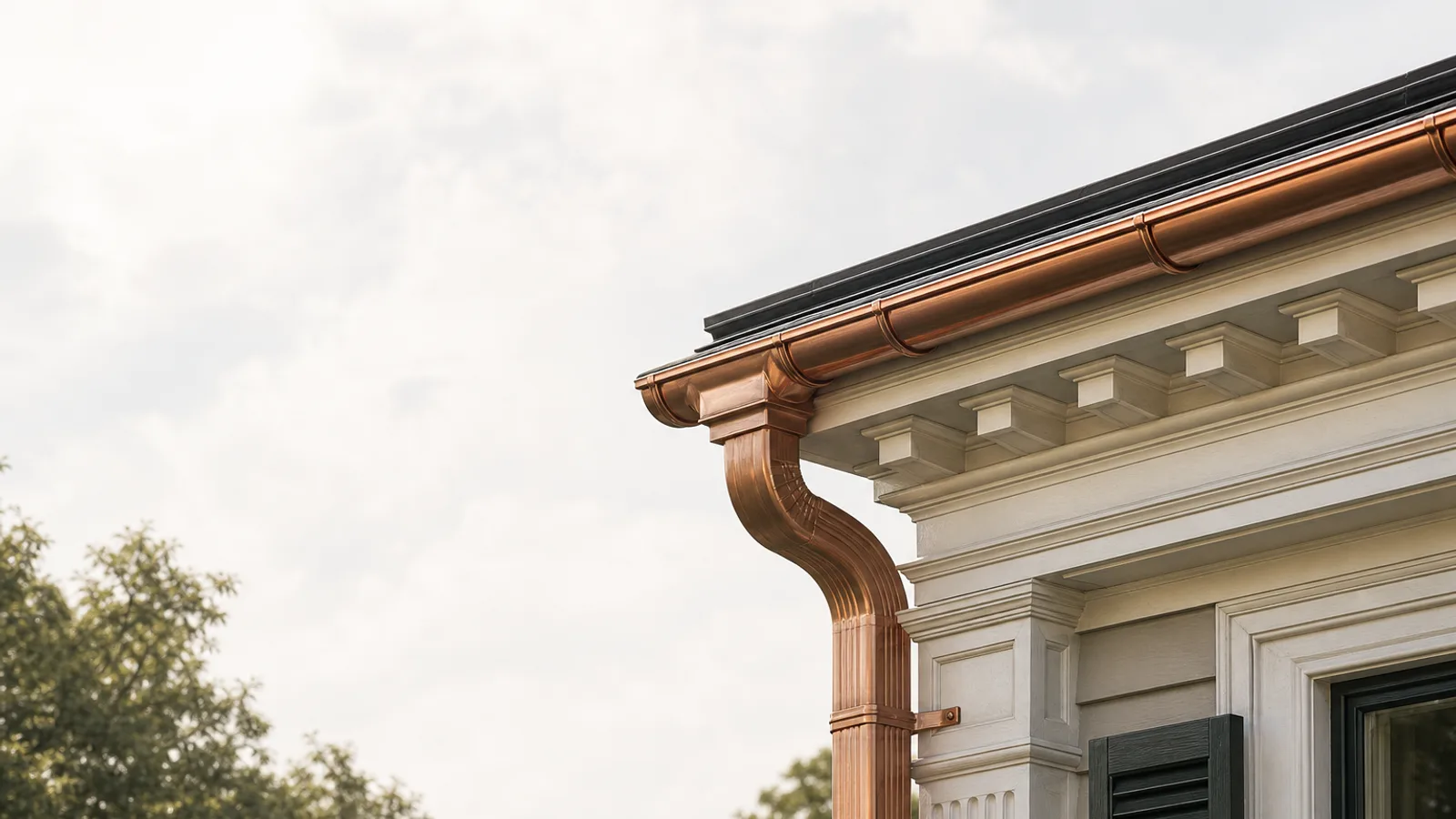
Several new regional guides focused on older neighborhoods have zeroed in on the same theme: the clash people complain about on historic homes is less about modern metal and more about the wrong shapes and attachment methods. For prewar Tudors, 1920s cottages, and early‑century Victorians, recent experts keep coming back to half‑round gutters as a more natural fit. That curved shape tends to echo existing trim and helps gutters read like part of the original design rather than something tacked on during a quick renovation. In contrast, tall K‑style gutters, especially in bright white, can cut across bargeboards and decorative cornices in a way that looks abrupt from the street.
Newer guidance for historic homes also points out that the hardware you barely notice on a newer vinyl‑sided house can become the main visual problem on an older facade. Round downspouts located out at the building corners often work better with bay windows and sculpted brickwork than squared‑off, oversized pipes. Strap or decorative hangers can sit more gracefully under exposed rafter tails than hidden spike‑and‑ferrule systems that drive through delicate trim. Those same sources caution against mixing metals in visible ways, both for appearance and to avoid corrosion where different materials meet. Taken together, the advice is clear: if you justify the price of copper on aesthetics, you will not get your money’s worth if you keep a clashing modern layout or hardware style.
- Half‑round gutters usually look more at home on Tudor, Victorian, and Craftsman styles.
- Round downspouts tend to blend better with curved trim and older brickwork.
- Visible strap or decorative hangers can suit exposed rafter tails and bracketed eaves.
- Mixing metal types on the same system can cause staining and galvanic corrosion.
How new historic home gutter guides are tightening expectations by architectural style
Recent historic home gutter guidance is much more specific by style than older, generic advice. For Craftsman bungalows and certain Tudors, newer recommendations lean heavily toward half‑round gutters paired with round downspouts. The reasoning is that these homes were built to showcase structure: rafter tails, purlins, and bracketed eaves were meant to be seen. Installing a deep boxy gutter that hides that rhythm changes the entire feel of the roofline. For Spanish Revival, Mission, and some stuccoed homes, several experts are now reminding owners that the original drainage may not have been an external gutter at all, but parapet drains or scuppers that carry water to discrete points.
For Mid‑Atlantic homeowners, the message is that “historic” is not a single category. A Victorian in coastal New Jersey may call for more ornate end caps and shaped conductor heads to look right, while a 1920s brick Tudor in Pennsylvania is better served by simple half‑round runs that pull shadows along the fascia line. Newer commentary also highlights how steep, multi‑gabled roofs on older homes can create short, intense waterfall zones that need careful outlet placement and bigger downspouts, even when you are trying to keep a slim profile. As you weigh investments like copper, it is worth mapping where your current system overflows and asking whether that layout is driven by convenience or by your home’s original design logic.
- Match gutter profile to the home’s era and roof detailing, not just to what is common today.
- Check whether your style originally used external gutters, box gutters, or scuppers.
- Plan downspout locations so they do not cut across important trim or porch features.
- Adjust outlet sizes for steep, complex roofs that dump water quickly in small areas.
What the longer copper lifespan means for ROI on a historic facade that already feels "off"
Industry summaries now put copper’s service life in the 50‑ to 100‑year range when it is installed and maintained correctly. That number is central if your current gutters are a sore spot every time you look at your house. With aluminum often framed in the 20‑ to 30‑year band, a switch to copper is not just a cosmetic tweak. It is a structural commitment across multiple decades of storms, paint cycles, and even resale. If you expect to stay in your home for a long time, a well‑designed copper system can make sense on a per‑year basis, especially if it prevents water damage that would be far more expensive than the gutters themselves.
On historic homes in particular, longer life also means longer exposure to mistakes. One of the less‑discussed realities in recent reporting is that copper will change color over time, cycling from bright to a darker brown and potentially to a green patina. That slow shift can be a benefit on older brick or stone because it softens the metal and lets it recede visually. However, it can be jarring on very light siding or trim, especially if runoff staining develops where water sheets over an undersized gutter or where joints are not sealed cleanly. The new cost and lifespan statistics create a practical test: if you are not ready to rethink layout, profile, and flashing at the same time, it may be premature to jump straight to copper.
How new attention to historic review rules affects copper gutter timing in the Mid‑Atlantic
Recent guides focused on historic districts have been reminding homeowners that gutter changes are no longer invisible to local review boards. In several regions, any visible change to the exterior, including a switch from painted aluminum to bare copper or from a rectangular profile to half‑round, can trigger a request for approval. The same holds for alterations that hide or cut through visible features such as rafter tails or decorative cornices. If your home sits in a designated historic district in Pennsylvania, New Jersey, Delaware, Maryland, or Virginia, that trend matters as you plan a project that involves copper.
In practice, this means you may need to align three moving pieces at once: your budget based on current copper pricing, the design decisions that will keep the system from clashing with the house, and the paperwork schedule for any required approvals. Because copper projects are so price sensitive to details like metal thickness, special hangers, and integration with older roofs, you may want to sketch at least two alternatives before you start any review process. One common pattern is to present a preferred copper half‑round design and a backup in a painted metal that closely matches existing trim. For many owners in the Mid‑Atlantic, a detailed proposal that shows how the new gutters respect original features is the simplest way to keep the project from stalling right before winter storms arrive.
How to use the newest copper gutter numbers when you talk to an installer
With the latest industry data setting realistic mid‑two‑figure per‑foot expectations for copper, the conversation with an installer should shift away from vague ballparks and toward line items. You will want any estimate to break out material thickness, total footage, number of miters, downspout sizes, and whether there is extra labor involved in protecting original trim or fascia. That level of detail lets you compare the national ranges you have seen with your own project, and it also gives you a chance to flag places where profile or hardware choices might clash with your home’s style.
If you know you are leaning toward copper, it is reasonable to say so upfront and focus the discussion on layout and look. You can ask the installer how they plan to handle tricky roof intersections, whether they recommend half‑round or another profile for your specific house, and how they will fasten gutters without chewing through decorative elements. For many Mid‑Atlantic homeowners, it can also help to ask how a contractor sequences copper work with other upgrades like gutter guards or fascia repair. If you are already researching copper gutter installation, this is the moment to make sure the project solves both the practical drainage problems and the “clashing gutter” look that pushed you to consider copper in the first place.
- undefined
- undefined
- undefined
- undefined
- undefined
- undefined
- undefined
- undefined
- undefined
- undefined
Frequently asked questions
- How much do copper gutters really cost to install on a house?
- Recent industry summaries put installed copper gutters in roughly the mid‑two‑figure range per linear foot for many homes, with exact pricing driven by metal thickness, region, and project complexity. That means even a modest 150‑foot system can run into several thousand dollars before extras like decorative elements or fascia repair.
- Are copper gutters worth it on a historic home compared to aluminum?
- Guides that compare materials often cite 50 to 100 years as a realistic service life for well‑maintained copper, versus about 20 to 30 years for many aluminum systems. On a historic home where appearance and long‑term durability matter, paying more upfront can make sense if the design suits the architecture and prevents water damage to original features.
- Will copper gutters clash less with my historic home than white K‑style gutters?
- They can, but only if the profile and layout respect your home’s style. Recent historic home guidance stresses that half‑round gutters with round downspouts and thoughtful hanger choices usually look more at home on Tudors, Victorians, and Craftsman houses than tall K‑style sections, regardless of metal.
- Do I need permission to install copper gutters on a house in a historic district?
- Several recent guides on historic neighborhoods warn that visible exterior changes, including switching gutter materials or shapes, often require review board approval. Before you schedule an installation, check your local historic commission’s rules or your municipality’s website so you do not have to redo work that was installed without clearance.
- How long will it take for copper gutters to turn green on my house?
- The patina timeline depends on local climate, pollution, and exposure, but it generally happens over years rather than months. In many Mid‑Atlantic settings, copper first darkens to a brown tone and may take a decade or more to develop the familiar green in exposed areas, if it develops at all.
- What should I ask a contractor before moving ahead with copper gutter installation?
- Ask how they will size and route gutters and downspouts to match your historic home’s style, what copper thickness they recommend, and how they plan to protect original trim and fascia. It also helps to request a written breakdown of materials and labor and to see examples of half‑round or other profiles they have installed on older homes.
Talk to All Pro Gutter Guards about copper gutter installation →