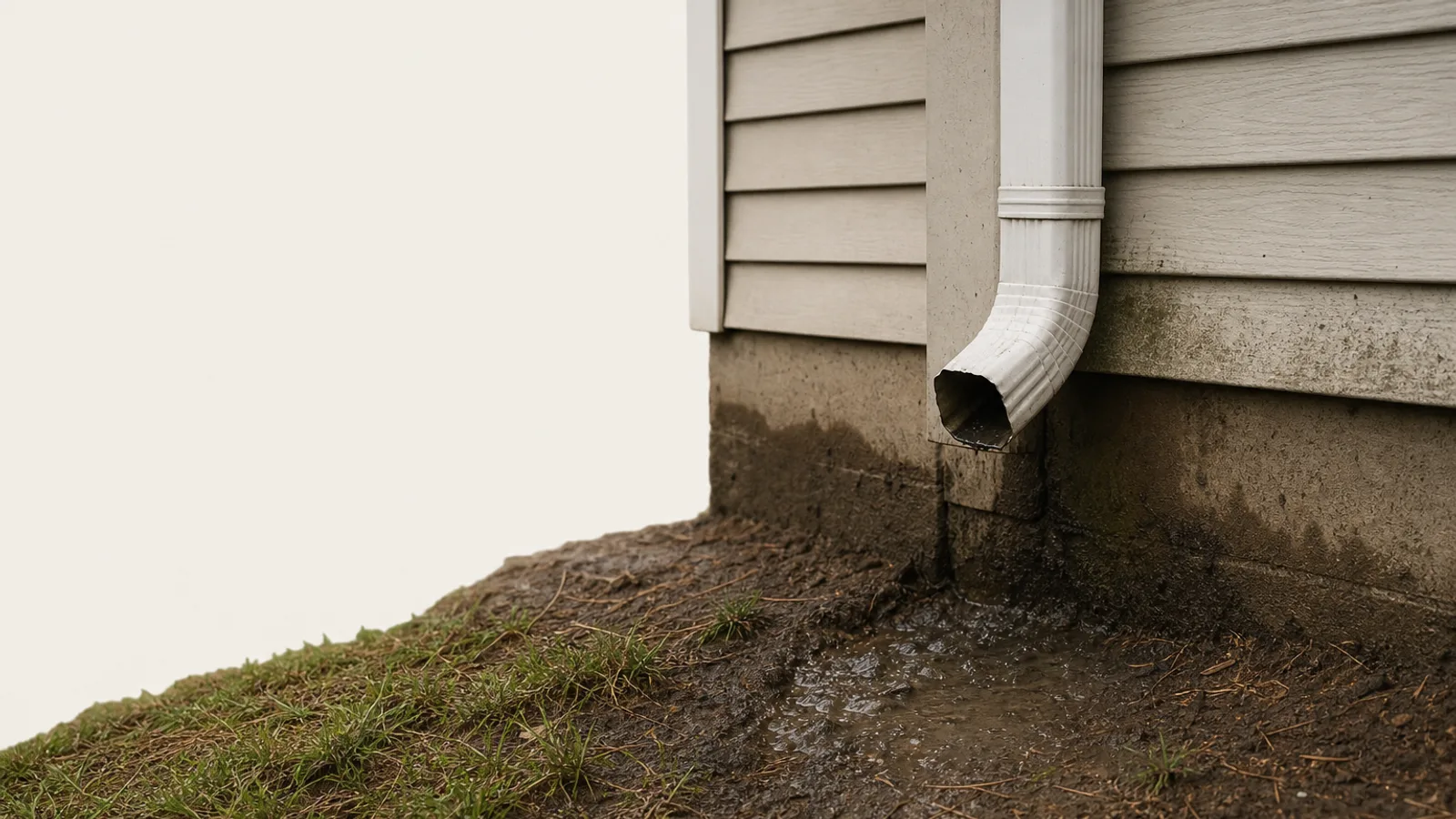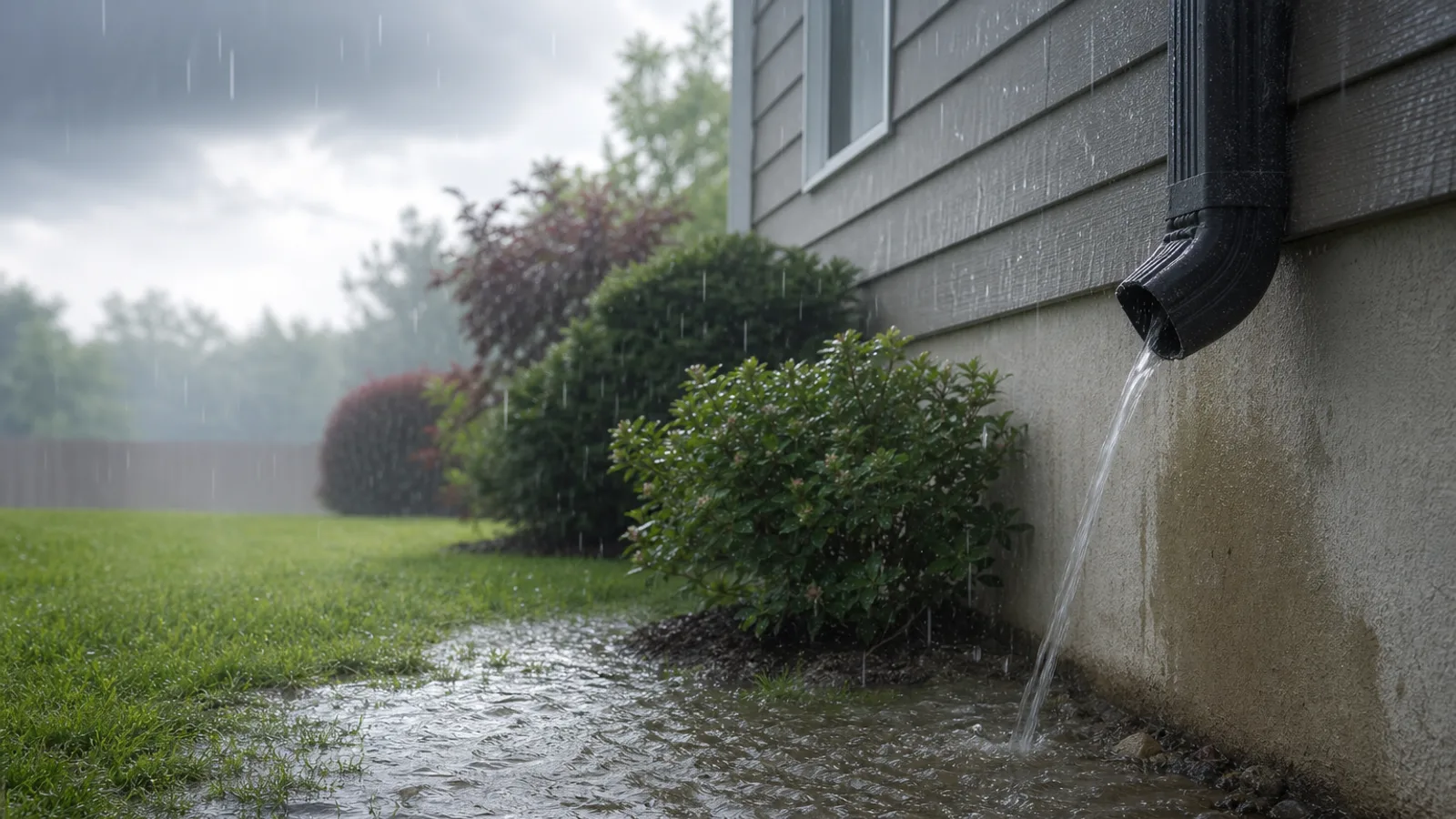
Water pooling along your foundation usually points to drainage and downspout problems, not just a wet week. This guide walks you through the first steps to protect your home and when it makes sense to upgrade your downspout setup.
What is water pooling at the foundation really telling you?
When you see water standing along your foundation after a storm, it is rarely just a cosmetic puddle. That water is trying to go somewhere, and if it cannot move away through the soil or a drain, it will press against your wall, slab, or crawlspace. Federal and energy efficiency guidance treats this as a serious design issue, not an annoyance, because persistent moisture at the foundation can shorten the life of materials and increase the chance of leaks. The ground around a home is supposed to shed water away, and your roof drainage should feed that system instead of fighting it.
Two big systems control what happens to rain that hits your roof. One is the surface drainage around your house, meaning the slope of the soil and any hard surfaces. The other is your gutters and downspouts, which are basically a pipeline from the roof edge to the ground. When either of those is undersized, damaged, or aimed the wrong way, water will naturally collect at low spots around the foundation. Before you jump to expensive waterproofing, it pays to understand how those simple pieces should work and what small things you can check first.
How should your yard and foundation be sloped to keep water away?
The ground around your home is the first line of defense against pooling water. Federal rules for manufactured homes require that sites be graded so the surface drops away from the foundation, with a minimum recommendation of roughly half an inch per foot for the first ten feet. A separate energy and building science handbook translates this into a practical rule of thumb for conventional houses: the soil should fall about six inches over that same ten foot distance. Both are saying the same thing in different ways. If the ground is flat or dipped toward the house, water will cling to the wall instead of draining off.
In practice, you do not need survey equipment to spot a grading problem. During or right after a decent rain, walk the perimeter and look for places where water runs toward the house, stalls against a planting bed, or sits in a depression right beside the wall. Hard surfaces such as patios, walkways, and driveways can make things worse, because they move water quickly and it will flow wherever their surface aims it. If that aim is toward the house, you can get a stream of runoff dumping directly into the soil at the foundation. Understanding that basic slope picture sets up every other decision you will make about downspouts and drainage.
- Stand back and eyeball whether the soil drops away from or toward the house.
- Watch how water moves off patios and walks in a steady rain.
- Look for low spots that stay soggy a day or more after storms.
- Note any areas where mulch beds or landscaping block water from draining away.
Why are downspouts so important when water is pooling?
Downspouts are where rooftop water meets the ground, so they often decide whether your foundation stays dry or gets soaked. Building science guidance recommends that downspout outlets do not end right at the base of the wall. Standard practice is to carry that flow at least several feet away from the house, and when the water is piped underground, the outlet is typically ten feet or more from the foundation. The same guidance stresses that any buried pipe that carries downspout water away should be solid rather than perforated in the near-foundation zone and should have a steady slope so water does not sit in the line.
If your downspouts simply dump water into a short splash block or straight onto a narrow strip of soil, then every rain is soaking the same band of ground against your house. That constant saturation can defeat even well graded soil because the volume of water is concentrated in one narrow area. When you combine that with compacted ground or clay that does not drain well, the result is the ponding you see. This is why correcting downspout placement and discharge distance is usually one of the highest value first moves. It changes the starting point of where the water hits the ground, which relieves pressure on everything else.
- Check whether downspouts end within a couple of feet of the wall.
- Look for signs that water has been eroding soil near downspout outlets.
- Notice any downspouts that routinely overflow in heavy rain.
- See if underground downspout extensions have visible, working outlets.
What should you inspect first when you notice water pooling?
Before you buy materials or call anyone, take one good rain and turn it into an inspection. The simplest method is to walk around your home while it is raining or right after, and watch where water flows off the roof, through the gutters, and out the downspouts. A consumer home maintenance guide stresses how powerful this kind of basic observation can be. You are looking for overflowing gutters, waterfalls from roof edges without gutters, and downspouts that immediately create streams or puddles against the house. Take notes or photos, because small patterns are easier to see when you compare different corners and walls.
Once you have the big picture of flow paths, look closer at specific trouble spots. At a pooling location, ask yourself three quick questions. Is there a downspout nearby that feeds that area. Is the ground sloped so water can leave, or is there a rim of soil or a hard surface trapping it. And does that spot stay wet long after others have dried out. At the same time, notice any gaps where a long roof edge has a lot of water but no downspout within a reasonable distance. That can mean the gutter is carrying too much flow and is more likely to overflow in a storm, sending water straight down the wall.
When is it time to correct grading versus upgrade downspouts?
Grading and downspouts work together, so deciding what to tackle first depends on what your inspection shows. If your downspouts already carry water well away from the foundation and you still have pooling, that points to soil slope and the way hard surfaces are arranged. In those cases, regrading a strip of soil, cutting a shallow swale, or adding a way for water to exit around a patio edge may be the right first move. Federal rules for home sites even specify that where you cannot achieve proper slope away from a structure, you should provide alternative drainage routes like shallow channels or drains.
On the other hand, if you see multiple downspouts ending within a couple of feet of the wall, or outlets that have no defined path for water to leave, the simplest and most effective change is often at the downspout. Extending a discharge point so it reaches five feet or more away from the wall, or tying it into a properly sloped buried line that daylights farther out, can relieve a lot of pooling without moving soil. Building science guidance recommends non perforated lateral pipes in this zone, laid with a consistent fall, so water does not sit against the foundation in the pipe itself. Often, homeowners end up doing a combination, with basic grading fixes around the house plus a more deliberate downspout installation on key corners.
How does professional downspout installation change your water picture?
A professionally designed downspout layout treats every roof area as a source that needs a safe exit path away from the house. That means looking not just at where downspouts currently land, but at whether the number and size of downspouts match the roof area and local rainfall. Guidance from energy and building programs emphasizes properly sizing gutters and downspouts and then making sure each outlet has a destination that does not keep the surrounding soil saturated. This usually involves discharging water at least several feet away from the foundation and, in some configurations, much farther when it is carried through underground piping.
For many homeowners who keep seeing the same wet corner or damp basement wall, this is the step where do it yourself fixes run out of steam. Short plastic add ons or improvised splash blocks may help in small storms but can be knocked out of place or overwhelmed. A dedicated downspout installation service typically sets permanent extensions, splash protection, or buried lines at the right distances and slopes. Professionals also understand how to work with existing drains and site slopes so that water exits at a safe location without backing up. While the exact approach varies house by house, the goal is always the same: get water from the roof into the ground far enough from your foundation that it can soak in or run off without causing pooling next to your walls.
What happens if you ignore long term pooling near your foundation?
Persistent water along the base of a wall does not always lead to an instant leak, which is why it is tempting to ignore. Over time, though, that moisture raises the risk of several kinds of damage that cost more to deal with than drainage fixes. Federal foundation guidance notes that in areas with poor draining soils or standing water, builders often add perimeter drains and moisture barriers to keep water from building up against the structure. If your home was built without those extras, constant pooling means the only thing resisting that water is the basic wall or slab and the soil itself.
The International Residential Code also reflects this concern in its foundation chapter. Where basements or crawlspaces sit below grade, it expects some combination of dampproofing, waterproofing, and drainage so that water does not stay against the wall. When the outside stays saturated, hydrostatic pressure rises, small openings are more likely to admit water, and moisture can find its way through joints at the base of the wall or slab. Even if water never appears inside, exterior materials, coatings, and nearby walkways can move or crack as soils repeatedly expand and contract. That is why early, relatively simple steps like improved downspout discharge and basic grading are worth taking seriously if you want to avoid larger structural or waterproofing projects down the road.
- undefined
- undefined
- undefined
- undefined
- undefined
- undefined
- undefined
- undefined
- undefined
Frequently asked questions
- What is the first thing I should do when I see water pooling near my foundation?
- Start by watching how water moves around your house during a decent rain. Note where it leaves the roof, how the gutters and downspouts handle it, and exactly where it ends up on the ground. That simple observation will usually reveal if overflows or poorly placed downspouts are feeding the pooling area.
- How far should downspouts discharge water away from my house?
- Building and energy guidance recommends that downspout outlets do not end right beside the wall and that roof runoff be carried several feet away. When water is piped underground, outlets are often placed around ten feet away from the foundation. The goal is to move concentrated roof water far enough out that it can soak in or drain without saturating the soil at the wall.
- Could bad grading alone cause water to pool at my foundation?
- Yes, if the ground around your home is flat or sloped toward the house, rainwater can naturally collect at the base of the wall. Federal site standards and energy guidance both call for the soil to drop several inches over the first ten feet away from the structure to prevent that. However, grading problems often show up together with short or misdirected downspout outlets, so both are worth checking.
- When do I need a professional downspout installation instead of DIY extensions?
- If you have multiple problem areas, long roof runs, or downspouts that need to connect to buried piping or drains, a professional installation is usually the safer route. Pros can size and place downspouts based on roof area and local rainfall, then set extensions or underground lines at the correct slope and distance. That reduces the risk of clogs, backups, or water discharging in the wrong place.
- Will fixing downspouts and grading always stop basement leaks?
- Improving downspouts and grading often reduces the amount of water pressing against basement walls, which can help with moisture problems. However, if your home sits in an area with a high water table or very poor draining soils, you may also need perimeter drains, sump discharge, or wall waterproofing. Current residential codes and federal foundation guidance both recognize that combination in more demanding sites.
- Is a little ponding near my foundation after heavy rain really a big deal?
- An occasional shallow puddle that disappears quickly is less concerning than spots that stay wet long after the rest of the yard has dried. Persistent pooling right at the wall means the soil there is repeatedly saturated, which increases the chance of seepage, material deterioration, and movement in surrounding surfaces. It is usually cheaper and easier to correct the drainage pattern now than to repair foundation or interior damage later.
Talk to All Pro Gutter Guards about downspout installation →