Missing or failed downspouts can turn one heavy storm into foundation damage, code violations, and mold. Learn how to tell if you need emergency downspout installation, what drives the cost, and how to protect your home while you wait for a crew to arrive.
What actually counts as an emergency downspout installation?
You do not need emergency service every time you see water on the ground, but some downspout problems should be treated as urgent. The main job of a downspout is to move roof water away from your foundation and siding. When that job is not happening in a storm, water concentrates around the base of the house and behind finishes where you cannot see it. Technical guidance for gutters and downspouts stresses that wet soil right next to the foundation can lead to structural movement, mold growth, and decay in framing and sheathing, so the stakes are higher than just a puddle.
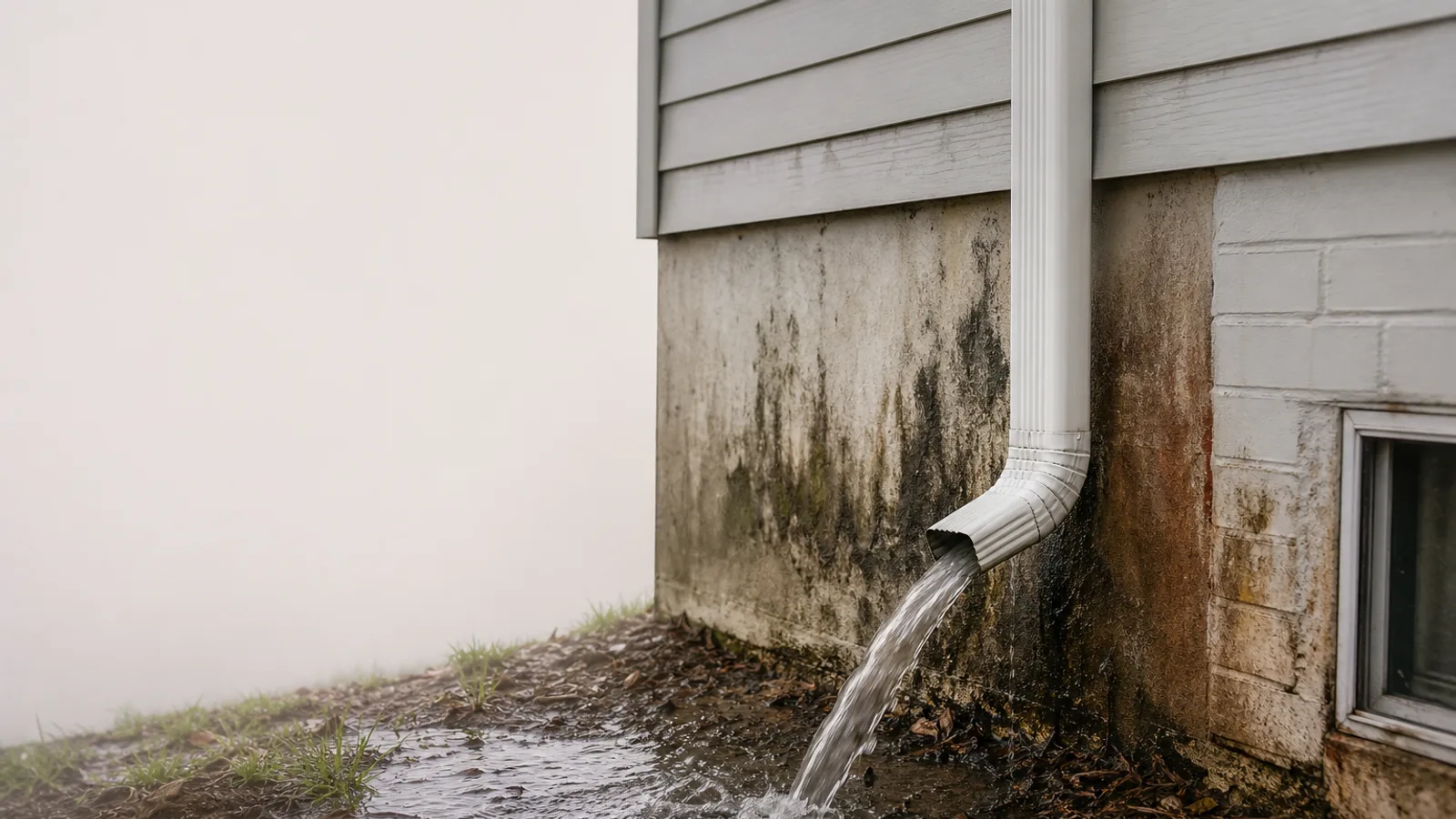
You are dealing with an emergency if your gutters are overflowing at the corners because there is no downspout, if a downspout has broken off and water is falling directly against your foundation, or if basement water, new wall stains, or musty odors appear during rain. Municipal maintenance rules echo this by treating missing, leaking, or damaged downspouts as urgent issues that can cause dampness and deterioration. That is different from a long-term upgrade, such as adding an extra downspout to even out gutter runs, which can usually be scheduled. When in doubt, look at what happens in an active or recent storm: if water is hitting the house, pooling right at the edge of the foundation, or getting inside, you are in emergency territory.
- Water is entering your basement, crawlspace, or lower level during rain.
- A downspout has detached or is missing so water pours directly off the roof edge.
- You see new staining, bubbling paint, or mold on exterior or interior walls after storms.
- Soil at the foundation is washing out or staying saturated long after rain stops.
How bad is it to let a missing or failed downspout wait?
Letting a known downspout failure sit through several storms can cost more than the repair itself. Building science guidance points out that when roof runoff is not controlled, water saturates the soil immediately next to the foundation. Over time this can increase pressure on basement walls, weaken footings, and encourage small cracks to widen. Persistent moisture also feeds mold growth on wood framing, insulation, and drywall, even if you do not see standing water inside. What starts as a missing elbow or crushed extension can turn into a bigger structural and health problem.
Code enforcement experience backs this up. In places like Philadelphia, the property maintenance code requires roofs, gutters, and downspouts to be in good repair and free of obstructions so they do not cause dampness or deterioration. A missing or damaged downspout is explicitly treated as a violation because it opens the door to water stains, rot, and mold. That does not mean an inspector will be on your doorstep the next day, but it signals how seriously water issues are viewed. Every heavy rain that hits a house without working drainage is another chance for water to find its way into cracks, joints, and seams.
- Foundation movement or cracking from repeated soil saturation.
- Rot in rim joists, sill plates, and exterior sheathing hidden behind finishes.
- Mold growth in basements and wall cavities that is difficult to remediate.
- Exterior staining and peeling paint that shorten the life of siding and trim.
What does emergency downspout installation involve and how placement affects cost
Emergency downspout installation is less about a different product and more about timing, access, and getting the layout right on the first visit. Best practice guidelines recommend spacing downspouts roughly every 20 to 50 feet along a gutter run so that each section of gutter can drain without overflowing. They also call for a slight slope in the gutter toward the downspout opening so water keeps moving even in lighter rain. For an emergency fix this often means a crew needs to do two jobs at once: replace or add the downspout and correct any sagging or mispitched gutter that is contributing to the overflow.
Where the downspout ends is just as important. Technical resources advise that downspout extensions discharge at least 5 feet away from the foundation, and even farther when they tie into underground drainage. In practice, that can involve adding surface extensions, splash blocks, or piping across a yard to a safe discharge point. The more material and labor needed to carry water away from the house, the higher the final bill. Cost is also affected by the height of the house, the material and thickness of the downspout, and what it attaches to. Materials need to be properly supported with straps or hangers that are suited to the wall structure and sized to fit the pipe, and those details all take time during an urgent visit.
- How many feet of gutter feed the downspout run that needs work.
- Whether the gutter itself needs re-sloping toward the new or repaired downspout.
- How far from the foundation you want to carry water before it discharges.
- The number of straps, elbows, and fittings needed for a secure installation.
Do you need a permit for emergency downspout work in Pennsylvania and nearby states?
Homeowners often worry that they cannot touch anything drainage related until they have a permit in hand. In practice, the rules are more flexible when a failure is actively damaging the house. In Pennsylvania, for example, state construction regulations allow emergency repair or replacement of building equipment without waiting for a permit first, as long as the permit application is filed within three business days. That window exists so critical work such as stopping a leak or restoring drainage can proceed the same day a problem is found instead of sitting while paperwork is processed.
Local requirements in New Jersey, Maryland, Delaware, and Virginia vary by municipality, but the general pattern is that health and safety issues are not left open for long. Where property maintenance codes view missing or damaged downspouts as conditions that can cause dampness and deterioration, owners are expected to correct them in a reasonable time frame. For you as a homeowner, that usually means you can authorize prompt downspout replacement when you see active damage and handle any follow-up paperwork with your contractor or building department afterward. It is always smart to ask your installer how they handle permitting in your specific town, especially for larger drainage changes such as tying into underground piping.
How fast can someone realistically get to an emergency downspout in the Mid‑Atlantic?
In Pennsylvania, New Jersey, Maryland, Delaware, and Virginia, many gutter and exterior contractors reserve space in their schedule for urgent calls, especially during storm seasons. Some offer same-day quotes for gutter and downspout problems when a roofline is failing. Same-day installation is not guaranteed in every situation, particularly during widespread weather events, but next-day or within a few days is often realistic for a straightforward downspout replacement or extension. Larger projects that involve adding multiple new runs or tying into underground drainage might take a bit longer to coordinate.
What you can usually expect is a triage approach. If you call with an active leak or water coming into a basement, a contractor will often come out quickly to stabilize the situation, for example by attaching a temporary extension or redirecting flow, then return to complete a permanent installation. Your flexibility with appointment times helps in an emergency context. Clearly explaining what you are seeing during rain, sending photos if asked, and knowing where drainage can safely discharge on your property also speeds up the planning part of the visit.
What should you ask about materials and methods before you approve emergency work?
Speed matters during an emergency, but you still want an installation that will last. Industry specifications for gutters and downspouts call for gutters to be installed with a consistent pitch toward downspouts, for straps or hangers to be made of durable metal such as galvanized steel or similar, and for pipe sizes and wall thicknesses to match the load they will carry. Discharge points often use sturdy splash blocks, such as precast concrete, to spread water out and protect the ground near the foundation. On an urgent call, it is worth asking the installer to show you how the downspout is fastened, where the joints are sealed, and where runoff will go.
You should also ask how far from the house the water will be carried and whether future landscaping or paving plans will conflict with the new layout. A quick repair that sends water only a short distance from the wall may still leave soil saturated in heavy rain, especially on flatter lots. Best practice guidance that encourages at least 5 feet of separation from the foundation is a useful benchmark when you decide between a very short, cheap fix and a more robust installation. Clarifying these points up front avoids surprises and makes sure the emergency work is not something you need to redo in a year or two.
How can professional downspout installation work with existing gutters and guards?
If you already have gutters and possibly gutter guards on your home, emergency downspout work needs to tie into that system smoothly. Good practice is to confirm that the gutter segment feeding the problem area has the right slope toward the outlet and that the opening through any guard or cover is large enough to let water reach the downspout. Technical guidance for gutters suggests a modest slope along the gutter run so water moves steadily to each outlet. In an emergency visit, a technician may need to adjust hangers, change outlet locations, or cut guard openings to match the new downspout.
Because All Pro Gutter Guards manufactures its own guard products, a crew can typically match new outlets to your existing or planned guards and keep debris control working after the emergency is over. The same installation principles still apply: downspouts spaced appropriately for the length of gutter, secure straps on the wall, sealed joints, and extensions that discharge far enough away from the foundation. If you are considering upgrading your guards or gutters anyway, it can be efficient to address that at the same time as an urgent downspout fix. Your installer can explain how a new downspout installation service would fit with the rest of your drainage system so you are not paying twice for overlapping work.
- undefined
- undefined
- undefined
- undefined
- undefined
- undefined
- undefined
- undefined
Frequently asked questions
- When is a broken or missing downspout an emergency instead of a routine repair?
- A downspout issue is an emergency when water is hitting your siding or foundation directly, when gutters are overflowing at the corners during rain, or when you see water, staining, or mold inside shortly after storms. These signs mean roof runoff is no longer being carried safely away from the structure, which can quickly lead to foundation problems and rot.
- How far from my house should emergency downspout extensions discharge water?
- Building science guidance recommends that downspout discharge be at least several feet away from the foundation, with 5 feet or more a common benchmark. If water is still pooling near the wall at that distance, your installer may suggest longer extensions or piping to a better location on your lot.
- Can I get emergency downspout work done without a permit in Pennsylvania?
- In Pennsylvania, state rules allow emergency repair or replacement work to proceed without waiting for a permit first as long as the permit application is submitted within three business days. That lets contractors address active drainage failures quickly, then follow up with the local building department as required.
- What are the signs that a city inspector might flag my downspouts as a violation?
- Property maintenance standards in cities like Philadelphia list missing, leaking, or damaged downspouts as examples of roof drainage problems. Visible rusted-through sections, separated joints, or downspouts that no longer connect to a discharge point can all be treated as violations because they allow water to cause dampness and deterioration.
- How quickly can a contractor usually respond to an urgent downspout problem?
- Response time depends on weather and demand, but many exterior contractors in the Mid‑Atlantic region offer rapid assessments or same-day quotes when a roofline is failing. Same-day installation is not always possible in busy periods, yet straightforward replacements are often handled within a few days, with temporary measures used to protect the home in the meantime.
- Will an emergency downspout installation work with my existing gutter guards?
- Yes, a properly planned downspout installation can be integrated with most gutter and guard setups. The installer may adjust outlet locations, guard openings, or gutter slope so that water can reach the new downspout freely while debris stays out, keeping the overall system working together.
Talk to All Pro Gutter Guards about downspout installation →