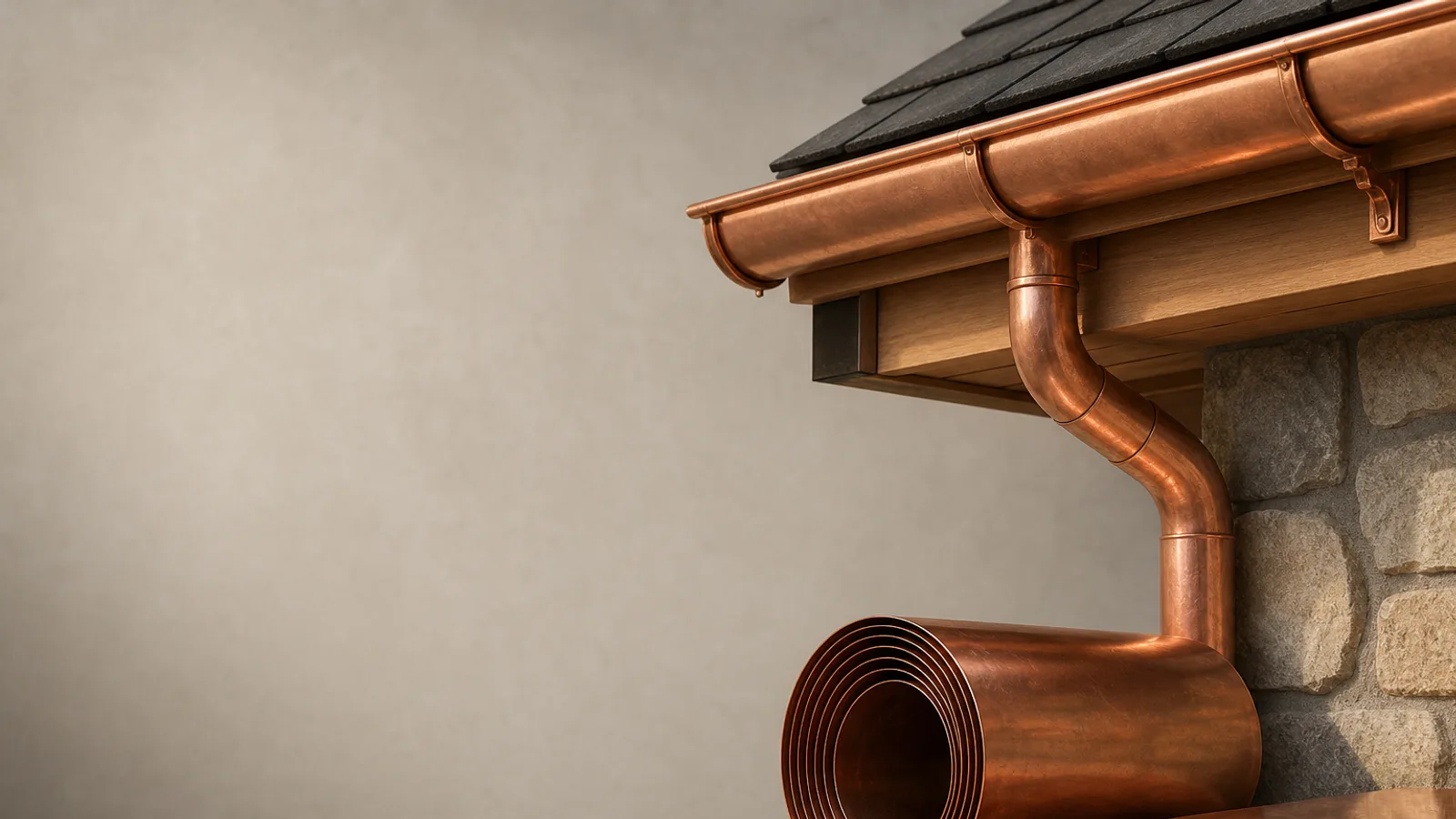
Copper gutters can last for decades, but only if the materials and installation are up to real architectural standards. Here is how to tell if you are paying for premium copper work or getting a cut‑rate system that will fail early.
Why some copper gutters last 60 years and others fail in 10
On paper, copper gutters all sound similar. The metal is the same color, every installer promises a long lifespan, and the upfront bids can be wildly different for what looks like the same job. The real differences show up in the details you cannot see from the ground: copper thickness, temper, seam type, hanger spacing, expansion control, and how closely the installer follows recognized design standards for copper in architecture.
Industry references that architects use treat copper gutters as a long‑term building component, not a disposable finish. The Copper Development Association’s handbook, for example, calls for copper sheet that meets ASTM B370, with specific ounce weights and tempers depending on whether the gutter is hung or built‑in. Historic and preservation programs also publish minimum design standards that go beyond basic builder practice. When your installer ignores those benchmarks in favor of thin metal or shortcuts at joints, you still get copper, but you no not get the durability you thought you were buying.
For homeowners in the Mid‑Atlantic, the climate only magnifies those differences. Freeze‑thaw cycles, heavy summer storms, and occasional snow loads stress gutters at their weakest points: seams, corners, and hangers. Premium copper gutters are built up to a specification so those points have margin. Cheaper systems are built down to a price, and that is where you see pulled screws, separated joints, or distorted sections long before the copper itself wears out.
- Premium copper gutters follow architectural design handbooks rather than ad‑hoc rules.
- Budget installations often cut corners on hidden details like joints and supports.
- Climate stress in the Mid‑Atlantic exposes weakness in cheap copper systems quickly.
- The copper itself rarely fails first; seams and fasteners do when they are undersized.
How copper thickness and temper separate premium from budget jobs
The first place installers quietly downgrade a copper gutter project is the metal itself. Copper sheet for building work is standardized by ASTM B370, which covers chemistry, available ounce weights, temper, and thickness tolerances. Within that standard, there is still a wide range. Architectural guidance for gutters generally recommends 16 ounce copper per square foot for typical hung gutters and 20 ounce for built‑in or more demanding applications. That translates to roughly 0.0216 inch for 16 ounce and about 0.0270 inch for 20 ounce copper.
Premium installations actually use those recommended weights and a temper that suits forming and long‑term performance, such as cold‑rolled tempers designated in the copper handbook. The material comes with traceability back to the mill so your installer knows what is going on the house. Cheaper work may still claim to meet the same general specification but sit at the low end of thickness tolerance, or substitute lighter material than an architect would call for in the same situation. You may not notice the difference on day one, but heavier copper resists denting, deformation at hangers, and oil‑canning along long runs of gutter.
Temper also matters. Softer tempers make forming easier but need correct support and slope so they do not sag under load. Stiffer tempers offer more rigidity but are less forgiving of sloppy fabrication at seams and corners. A premium installer matches temper and thickness to the profile, roof edge detail, and expected snow or ice loads. A budget approach simply buys whatever coil is cheapest that week and makes it work, which can leave you with a system that moves too much at joints or feels flimsy under maintenance ladders.
Soldered seams, hangers, and expansion: the craftsmanship differences
When you compare two copper gutter quotes, the line items that most change long‑term performance are usually labor details: how seams are joined, how supports are spaced, and how thermal movement is handled. The Copper Development Association’s design references and various historic design standards are very explicit about these points. They describe gutters and downspouts built from formed sections with riveted and soldered joints, not simple sealant, and straps or hangers spaced no more than about 30 inches apart on hung systems. They also call for built‑in allowances for expansion in long runs, with special details where lengths exceed several dozen feet.
Premium copper gutter installation treats seams as permanent connections. Joints at corners, miters, and end caps are carefully cleaned, mechanically fixed (often with rivets), then fully soldered to create a continuous metal path. This takes more time and skill, and it shows in the bid. Cheaper work often substitutes sealants alone at joints, or solders only the high‑visibility areas. That can look fine at first, but sealant ages very differently than copper and can crack or pull away long before the surrounding metal has even begun to patinate.
Support details follow the same pattern. A quality installer uses heavier hangers or straps that match the copper material and spacing that keeps the gutter straight under water and ice loads. In contrast, budget installations often stretch hanger spacing well beyond what design handbooks recommend, or use generic hardware that is not designed to work with copper. Over time, that can lead to sagging sections where water pools instead of draining, which in turn accelerates corrosion at seams and can spill water where you wanted protection.
- Premium seams are riveted and fully soldered, not just sealed with caulk.
- Quality hangers are spaced close enough to prevent sagging under load.
- Expansion joints or details are added where long gutter runs require movement.
- Cheap installations skip or thin out these steps to save labor and hardware cost.
What you actually pay for with premium copper gutter pricing
Copper gutters are never the low bid material, even at budget quality. Pricing guides that summarize current market conditions often show copper gutter systems in the range of about 25 to 45 dollars per linear foot installed, depending on profile, seam type, and job complexity. In those same guides, the higher end of the range is typically associated with thicker material, half‑round or special architectural profiles, fully soldered seams, and higher grade hardware and accessories. The lower end often reflects simpler shapes, thinner copper, or less intensive seam work.
From a homeowner’s perspective, the trick is understanding whether a higher number on a bid is tied to meaningful upgrades or just overhead. When an installer explains that they are using 16 ounce copper for standard hung gutters and stepping up to 20 ounce for certain built‑in sections, that matches what architectural references recommend for lasting performance. If they note that every joint will be soldered rather than only sealed, that correlates with the labor‑intensive methods described in historic and preservation design standards.
On the other hand, if a quote simply lists copper gutters at a per‑foot price with no mention of ounce weight, seam type, hanger spacing, or expansion provisions, you are likely looking at a budget interpretation of those same ranges. For homes in Pennsylvania, New Jersey, Delaware, Maryland, or Virginia where storms and temperature swings are a given, the small savings on a thinner, faster install can be wiped out quickly if the system needs constant repair. A premium approach aims to install copper once, then let it quietly do its job for decades.
How to read a copper gutter quote so you know what you are getting
The easiest way to separate premium copper gutter work from cheaper options is to make every bidder spell out their assumptions. A good proposal will name the copper standard and ounce weight, indicate whether the system is hung or built‑in, describe the profile, and note key construction details like soldering and hanger spacing. Some installers will even reference the same kinds of design handbooks that architects use, or point out that their practices align with published minimum standards for historic properties.
For homeowners comparing options, this level of detail is not about learning a new trade. It is about making sure you are not paying premium prices for budget work. If one proposal clearly lists 16 ounce ASTM B370 copper with soldered joints at all corners and a hanger spacing in line with architectural guidance, while another simply states “copper gutters installed,” you have a clear contrast. The detailed bid tells you how the installer plans to deliver the lifespan that copper is known for; the vague one asks you to trust that the cheapest version will be good enough.
If you are trying to decide whether copper is right for your home at all, it also helps to look at these details side by side with other gutter options. You may decide that where you really want copper is on the most visible faces or historic elements, while aluminum or another material makes sense on less prominent runs. A well‑written quote for copper gutter installation should make those trade‑offs clear, so you can decide where premium standards matter most on your roofline.
- undefined
- undefined
- undefined
- undefined
- undefined
- undefined
- undefined
- undefined
- undefined
- undefined
Frequently asked questions
- What makes a copper gutter installation premium instead of basic?
- Premium copper gutter installations follow recognized architectural guidance on metal weight, temper, joints, and supports rather than just meeting the bare minimum. That typically means at least 16 ounce copper for hung gutters, heavier copper where needed, fully soldered seams, and well planned hanger spacing and expansion details. The goal is to match copper’s potential lifespan, not just its appearance.
- How much should I expect to pay per foot for quality copper gutters?
- Recent pricing guides often show copper gutter systems running roughly 25 to 45 dollars per linear foot installed, with the higher end associated with thicker copper, more complex profiles, and fully soldered seams. If you see a quote below that range, it likely involves significant compromises in material or craftsmanship. Always ask what ounce weight and joint method are included at your price point.
- Is 16 ounce copper good enough for residential gutters?
- For most traditional hung copper gutters on homes, 16 ounce copper that meets ASTM B370 is widely referenced as a suitable minimum when paired with proper supports and detailing. Architectural handbooks and historic standards use that weight as a baseline for quality work. Built‑in gutters or more exposed situations often justify 20 ounce copper for extra margin against deformation and wear.
- Do my copper gutters really need soldered seams?
- Design handbooks for copper in architecture and preservation standards both describe riveted and soldered joints as the norm for durable copper gutter systems. Soldered seams create a continuous metal connection that ages at the same rate as the surrounding gutter. Sealant alone can work temporarily, but it typically fails long before the copper itself, which leads to leaks and repeat repairs.
- Why does hanger spacing matter so much for copper gutters?
- Copper is a relatively soft metal compared to steel, so the spacing and type of hangers or straps directly affect how straight and stable your gutters stay. Architectural guidance for copper gutters usually limits spacing to around 30 inches for hung systems so sections do not sag under water or snow loads. Stretching that spacing to save on hardware is a common budget shortcut that shortens system life.
- How can I tell if my copper gutter quote meets real design standards?
- Check whether the proposal names ASTM B370 for the copper sheet, specifies 16 ounce or 20 ounce weights, and mentions soldered seams and support spacing. References to copper design handbooks or historic minimum standards are another sign that the installer works from a clear specification. If those details are missing, ask the contractor to add them so you know whether you are buying premium or budget work.
Talk to All Pro Gutter Guards about copper gutter installation →