If your gutters clog every fall, choosing between micro-mesh and reverse-curve gutter guards can feel like a guess. This comparison walks through how each style performs, what they cost, and which one usually makes more sense for homes in PA, NJ, MD, DE, and VA.
What are micro-mesh and reverse-curve gutter guards and how do they actually work?
If your gutters clog every fall, the first question is not the price tag, it is how each style of guard handles the exact debris that buries your gutters now. Micro-mesh and reverse-curve guards solve the problem in very different ways. Knowing those differences makes it much easier to look past marketing names and focus on performance on your roof.
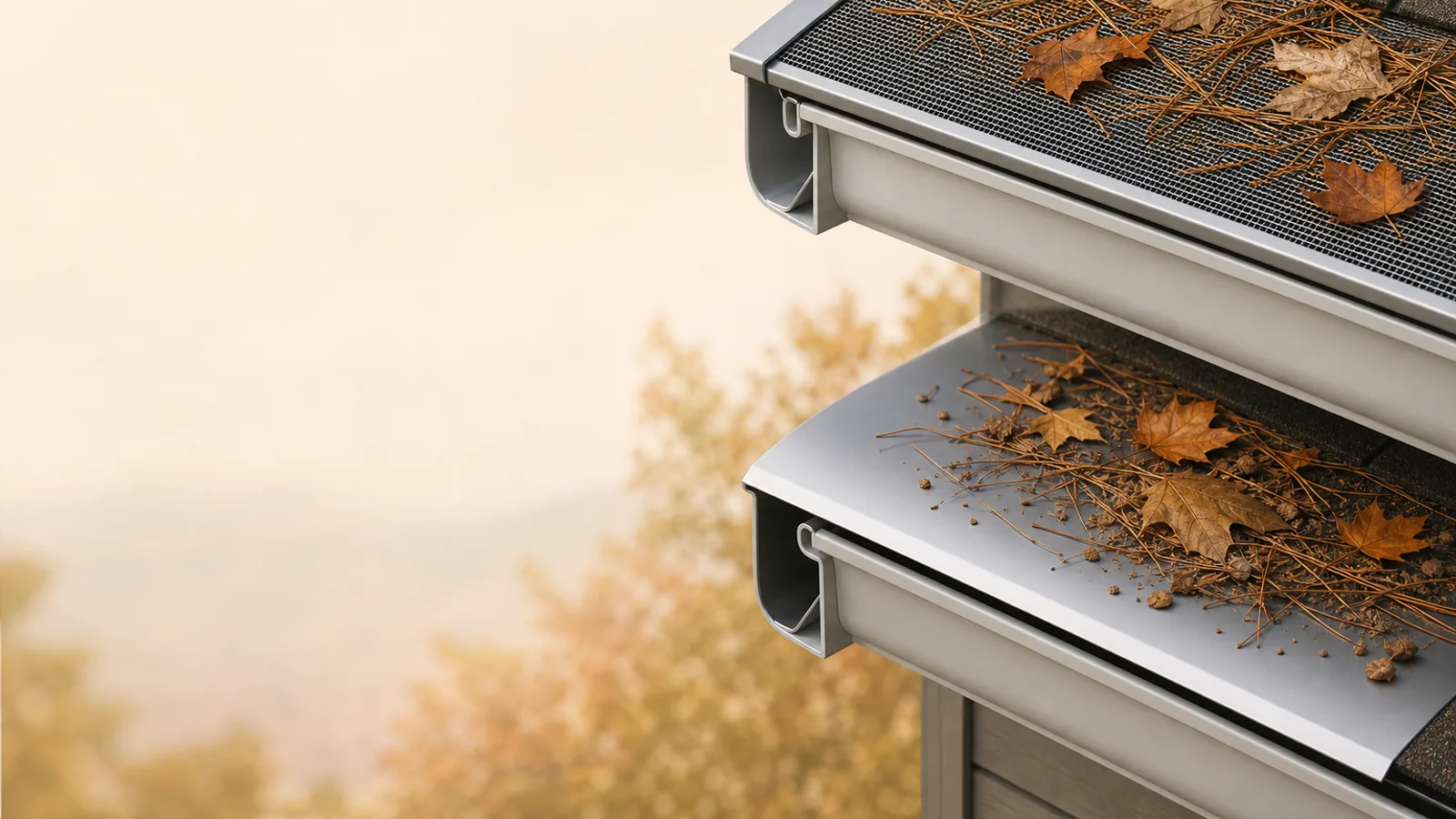
Micro-mesh guards use a fine stainless steel or similar screen mounted over a supporting frame that sits on top of your existing gutters. The openings are tiny, often in the 30 to 150 micron range according to contractor comparisons, so they act like a filter that lets water through while stopping most leaves, pine needles, and shingle grit before it enters the gutter. Reverse-curve guards, often called surface-tension or hooded systems, cover the gutter with a solid, curved cap. Water follows the curve into a slot on the front edge while larger leaves tend to slide off to the ground. Instead of filtering water, they rely on water sticking to the metal curve. Both ideas can work well, but they handle fine debris and very heavy rain in very different ways.
In the Mid-Atlantic, where oak and maple leaves, helicopters, and pine needles often fall together, that difference in design becomes critical. Fine debris is what slowly fills your gutters and downspouts between big storms. Because micro-mesh physically stops these particles at the surface, any buildup is visible and can usually be brushed away. With a reverse-curve design, small debris may ride the water into the slot or sneak around the edges and collect inside the gutter, which can keep you climbing a ladder even after an expensive guard system is installed.
- Micro-mesh uses a very fine screen to filter water.
- Reverse-curve uses a solid hood and a curved edge.
- Micro-mesh is better at stopping small debris and grit.
- Reverse-curve focuses on shedding large leaves off the roof.
How does each guard style handle fall leaves, pine needles, and heavy rain?
For homes that clog every fall, performance with your specific mix of debris matters more than any brochure claim. Regionally in New Jersey and nearby states, contractors with long experience tend to rate micro-mesh systems as the best all-around option for blocking oak and maple leaves, helicopter seeds, pine needles, and shingle grit in one design. The fine openings in the mesh can stop very small particles, which is especially important if your roof sits under pines or older asphalt shingles that shed granules.
Reverse-curve guards tend to shine in situations with mainly large, broad leaves and fewer needles. The curved hood encourages leaves to slide off, which can keep roof edges tidy. However, several trade sources report mixed results where debris is varied. Maple seeds and pine needles can catch at the front opening of these systems, and in heavy storms water can overshoot the lip, leading to splashing around foundations. Micro-mesh systems are not perfect either. Very high volume rain can momentarily overwhelm a fine screen, causing some water to shoot over the edge. But many modern micro-mesh designs are built with ridges or channels underneath to move more water quickly into the gutter trough.
If you live in Pennsylvania, New Jersey, Maryland, Delaware, or Virginia, your fall usually brings not just leaves but also wind-driven rain. That is why it helps to think about the worst day, not the average one. A micro-mesh guard that matches the pitch of your roof and is securely fastened can usually keep up with these downpours, especially when supported by a good size gutter. A reverse-curve system may do fine in moderate rain but can be more sensitive to roof pitch and installation angle. Improperly aligned hoods are more likely to let water shoot past the gutter entirely, which defeats the purpose when the ground below is already soaked.
- Micro-mesh blocks pine needles and shingle grit that cause slow clogs.
- Reverse-curve often handles broad leaves but can struggle with mixed debris.
- Both types can overshoot in extreme downpours if installed poorly.
- Roof pitch, gutter size, and tree types all change which system works better.
What do micro-mesh and reverse-curve gutter guards cost in the Mid-Atlantic?
Cost is usually the second big question, right after "Will this actually stop the clogs?" Across national and regional data, professionally installed micro-mesh guards typically fall in the lower to middle price range compared to many reverse-curve systems. One industry comparison places micro-mesh installed costs roughly between 5 and 20 dollars per linear foot, depending on the quality of the mesh and the complexity of your roof. Another regional guide focused on New Jersey notes that real-world installed prices for micro-mesh often fall in an 8 to 15 dollars per foot band when you include materials and professional labor.
Reverse-curve or hooded systems usually sit at the higher end. Detailed comparisons suggest that many surface-tension systems run around 15 to 35 dollars per linear foot installed. Part of that higher price often comes from more complex brackets, heavier covers, and in some cases bundled services or financing that drive up the total project cost. For an average home with typical roofline length, that difference can easily add up to several hundred or even a few thousand dollars more for a reverse-curve solution compared with a solid micro-mesh system.
Actual pricing for your home in Pennsylvania, New Jersey, Maryland, Delaware, or Virginia will depend on your roof pitch, the number of stories, gutter condition, and any needed repairs. Also, pure material ranges and full project prices are not the same thing. For example, national data lists micro-mesh materials alone in the roughly 1 to 10 dollars per foot range, with full professional jobs often around 650 to 2,400 dollars or more for an average home. In practice, what you pay locally is shaped by labor rates, access challenges, and whether you combine gutter guard work with new gutters or roof repairs. The important point is that reverse-curve systems rarely come in cheaper, so you should make sure the performance advantages they promise line up with the debris you actually see.
How long do these gutter guards last and what maintenance will you still have?
If you hate cleaning gutters, you probably want the longest possible break between ladder trips. The good news is that both micro-mesh and reverse-curve systems can offer very long service lives when built from durable metals and installed properly. Multiple guides note that stainless steel micro-mesh paired with a strong frame commonly carries 20-year or longer life expectations, with some manufacturers backing their products for 20 years or even for the life of the home. Comparisons that look at premium systems in both categories often speak in terms of "20 plus years" of service when materials and installation are solid.
Where they differ is how they behave during those years. Micro-mesh guards need occasional attention on the surface, usually in the form of a light brushing or rinsing once or twice a year to remove leaves and dirt that sit on top of the screen. Contractor reviews describe this as basic maintenance that most homeowners or a service provider can handle without opening up the gutter or removing the guard. Underneath the mesh, the gutter channel tends to stay relatively clean because fine debris never makes it inside in the first place.
Reverse-curve systems are marketed as virtually maintenance free, but long-running field experience is more mixed. While many large leaves will slide off the curved cover, smaller pieces can get held at the front gap, where they may decompose and form a mat. Some trade sources report that in real conditions, owners of these systems still need periodic cleaning of the gap and the gutter inside to clear fine buildup, especially on homes with pines or seed-bearing trees. Because of the way the hooded covers attach, that maintenance can sometimes be more involved than brushing off the surface of a micro-mesh screen.
In states like Pennsylvania and New Jersey, there are no statewide building codes that force you to choose one type of guard over another, so you are free to balance lifespan and maintenance against cost and appearance. The Uniform Construction Codes in these states focus on safety, structure, and weather resistance but do not regulate gutter guard openings or styles. That leaves you room to choose a setup that fits how often you want to think about your gutters at all once the system is installed.
Which gutter guard fits homes in PA, NJ, MD, DE, and VA that clog every fall?
For our region, the combination of dense tree cover, four distinct seasons, and mixed debris leans the decision in a fairly consistent direction. Contractor guides based on decades of work in New Jersey rank micro-mesh guards as the best overall choice in that environment, mainly because they handle the full mix of oak and maple leaves, helicopter seeds, pine needles, and shingle grit that are common here. A separate comparison that looks specifically at how different guard styles handle New Jersey conditions notes that reverse-curve systems do well with large leaves but tend to struggle when confronted with varied debris and can be more clog prone when pine needles enter the picture.
If your gutters clog every fall in Pennsylvania, Maryland, Delaware, or Virginia, your situation likely looks very similar. Yards in these states often mix deciduous hardwoods with pines, and many homes use asphalt shingles that shed granules as they age. In that setting, the fine filtering ability of micro-mesh usually provides more reliable protection. It keeps small particles out of the gutter body where they are harder to reach, and instead leaves them on top where a quick cleaning once or twice a year can reset the system.
Reverse-curve gutter guards can still make sense in some specific cases. If your roof sits under a few large leaf-dropping trees, you do not have pine needles, and you are drawn to the look of a solid cover, a well-installed hooded system can reduce heavy leaf loads. You will need to accept the higher upfront cost and be realistic that some maintenance may still be required to clear smaller debris from the front gap. For homeowners who rarely see fine debris and who prioritize a smooth, continuous look along the roof edge, that may be a reasonable trade-off.
For many people in the Mid-Atlantic, the more balanced choice is a professionally installed micro-mesh system sized to match your existing gutters and roof layout. It offers strong performance across debris types, typically at a lower price per foot than full hood systems, and it lines up with what regional contractors see working best over 20-plus year spans. If you decide you are ready to add guards, you can explore gutter guard installation options that are designed for the specific trees and roofs common in this part of the country rather than relying on a one-size-fits-all pitch.
- undefined
- undefined
- undefined
- undefined
- undefined
- undefined
- undefined
- undefined
Frequently asked questions
- Are micro-mesh gutter guards better than reverse-curve guards for heavy fall leaf drops?
- In many Mid-Atlantic yards with a mix of leaves, seeds, and pine needles, micro-mesh guards usually perform better overall. The fine openings block both large and small debris so the gutter channel stays clearer, while reverse-curve systems tend to be optimized for larger leaves and can be more vulnerable to small debris and mixed fall conditions.
- How much more do reverse-curve gutter guards cost compared to micro-mesh?
- Industry comparisons place micro-mesh gutter guard installations around 5 to 20 dollars per foot, while many reverse-curve systems fall closer to 15 to 35 dollars per foot. On a typical home this can add up to hundreds or thousands of dollars in extra upfront cost for a hooded system, so you should make sure the performance justifies the price for your debris pattern.
- Do micro-mesh gutter guards still need cleaning every year?
- Micro-mesh guards usually still need light maintenance, but it is different from full gutter cleaning. Most guides recommend brushing or rinsing off the top of the mesh once or twice a year to remove leaves and dirt, while the inside of the gutter tends to stay much cleaner because fine debris is blocked at the surface.
- Are reverse-curve gutter guards really maintenance free?
- Many reverse-curve systems are advertised as nearly maintenance free, but long-term contractor experience suggests you should still plan on some upkeep. Smaller debris can catch at the front slot or work into the gutter, so owners sometimes need to clear that gap or clean sections of gutter, especially in areas with pine needles or maple seeds.
- Will either type of gutter guard prevent overflow in very heavy rain?
- Both micro-mesh and reverse-curve guards can overflow in extreme downpours if they are installed poorly or paired with undersized gutters. Micro-mesh may shed some water over the edge if the screen is overwhelmed, and reverse-curve systems can let water shoot past the lip. Good sizing, correct pitch, and professional installation are key for both styles to handle heavy Mid-Atlantic storms.
- Do building codes in PA or NJ require a specific type of gutter guard?
- Statewide building codes in Pennsylvania and New Jersey do not dictate the type of gutter guard you must install. The Uniform Construction Codes in these states focus on structural safety and weather resistance and do not mandate micro-mesh, reverse-curve, or any other gutter guard opening size, so you are free to choose based on performance, cost, and appearance.
Talk to All Pro Gutter Guards about gutter guard installation →